Altitude sickness symptoms by stage: from mild to severe
Published 1 April 2026 · 10 min read
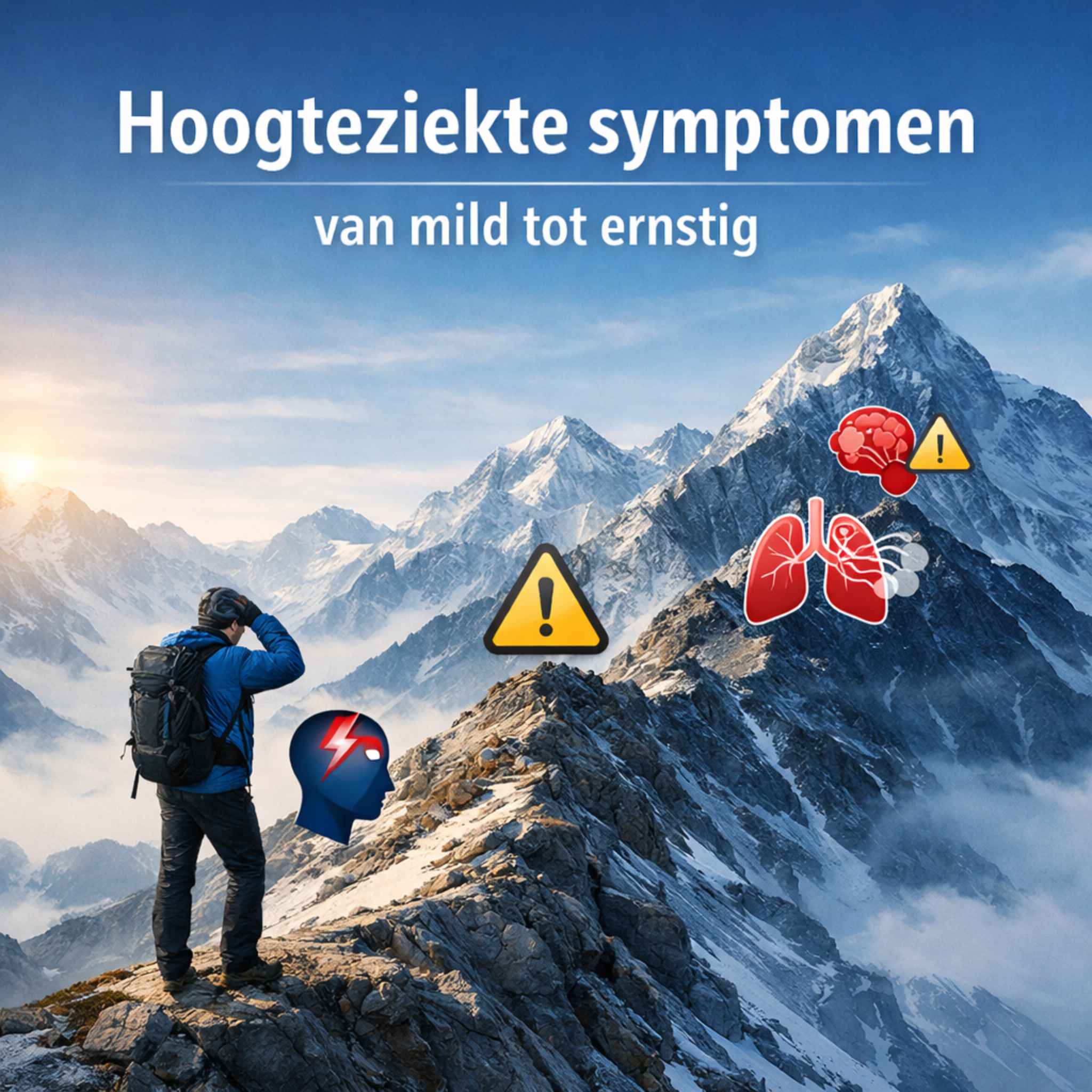
Recognising altitude sickness symptoms by stage is essential when travelling safely to higher altitudes. The first symptoms often seem harmless: a mild headache, reduced appetite, some nausea or poor sleep. Yet a mild beginning can turn into a serious situation if you keep ascending while your body is not yet sufficiently acclimatised. This is precisely why it helps not to see altitude sickness as one vague condition, but as a spectrum that runs from mild acute altitude sickness to life-threatening complications in the lungs or brain.
Those who understand the stages make the right decision faster. That means: resting in time, interrupting a climb, monitoring complaints objectively and descending immediately in case of alarm signals. Especially for trekkers, climbers and travellers towards 3,000 metres and higher, such knowledge often makes the difference between travelling responsibly and waiting too long.
The essentials in 30 seconds
Altitude sickness usually starts mildly with headache, nausea, dizziness or fatigue.
If symptoms worsen despite rest, then you should not ascend further and descending should be seriously on the table.
Chest tightness at rest, confusion or loss of coordination are alarm signals and require immediate action.
Short answer: these are the stages of altitude sickness
Altitude sickness is usually classified into three clinical levels:
- Mild: acute altitude sickness (AMS) with headache plus symptoms such as nausea, dizziness, fatigue and worse sleep.
- Severe neurological: cerebral oedema at altitude (HACE) with confusion, drowsiness, loss of coordination and sometimes altered behaviour.
- Severe pulmonary: pulmonary oedema at altitude (HAPE) with shortness of breath, decreasing exercise tolerance, coughing and later tightness at rest.
Acute altitude sickness usually develops within 2 to 12 hours of arriving at higher altitude or after a further ascent. Severe forms can develop quickly thereafter, especially if a person continues to ascend anyway. Headache is the classic core complaint in mild AMS, while shortness of breath at rest and neurological failure are appropriate in an emergency situation.
Why stage thinking is so important
Many people make the same mistake: they assess complaints in isolation. A little headache seems manageable. So does a bad night. Some nausea on the way may be due to food. But at altitude, you have to look at the pattern. Do the complaints arise shortly after a rapid ascent? Do they increase? Is hiking heavier than yesterday? Does someone feel slower, quieter or more awkward?
Stage thinking helps because it forces you to look not just at the complaint, but at its meaning. A mild form usually calls for resting, not rising further and observing carefully. A severe form calls not for waiting, but for descending and medical help where possible.
⚠️ Reality check
The danger of altitude sickness is rarely in the first light signal. The danger usually lies in underestimation. Those who consider mild symptoms normal and continue to ascend anyway increase the chances of a reversible situation developing into a real emergency.
Stage 1: mild altitude sickness symptoms
The mildest and most common form is acute altitude sickness. Which often presents as a kind of hangover feeling at altitude. The classic combination is headache with one or more additional symptoms. Think loss of appetite, nausea, dizziness, fatigue, lethargy or poor sleep. That pattern is consistently described by authoritative medical sources as the typical onset of AMS.
Importantly, mild is not the same as insignificant. You are not in immediate danger, but you do have a signal that your current acclimatisation is lagging behind your ascent. At this stage, you can often gain a lot with a break at the same altitude, extra rest, less exertion, drinking well and critically observing how the trend develops over the next 12 to 24 hours.
| Stage | Typical symptoms | What does this mean? | Practical rule |
|---|---|---|---|
| Mild AMS | Headache, nausea, dizziness, fatigue, poor sleep | Insufficient acclimatisation, but often reversible | Do not rise further, rest, complaints to follow |
| Worsening AMS | Severe headache, vomiting, marked exhaustion, not improving with rest | Risk of progression increases | Stop further ascent, seriously consider descending |
| HACE | Confusion, shaky walking, drowsiness, loss of coordination | Life-threatening brain involvement | Immediate descent and emergency action |
| HAPE | Shortness of breath, reduced exercise tolerance, cough, tightness at rest | Life-threatening lung involvement | Immediate descent and emergency action |
Stage 2: worsening symptoms to take seriously
The transition from mild to more severe is not always spectacular. You often first see that symptoms do not disappear while someone is taking rest. Headaches become more severe. Eating is hardly possible. Nausea turns into vomiting. Simple tasks feel heavy. Someone looks lethargic, talks less or mainly wants to lie down. These are not details, but signs that the body is not recovering sufficiently at the current altitude.
This is the tipping point where many mountain travellers make the wrong decision. They think: one more stage, soon it will be better. That is precisely what is risky. When symptoms of AMS worsen or do not improve, further ascent is no longer part of a sensible plan. Medical guidelines stress that resting at the same altitude is often appropriate for mild symptoms, but deterioration is a clear red flag.
🧭 In practice
The question is not just how bad a complaint feels, but whether the trend is in the wrong direction. A traveller who clearly brightens up after resting and eating is in a different situation from someone who continues to sink in energy, appetite and clarity at the same altitude.
Stage 3A: severe altitude sickness in the brain
The most serious neurological form is HACE, or cerebral oedema at altitude. This is no longer an ordinary headache. The picture then shifts to brain function itself. Typical alarm signals are confusion, abnormal behaviour, drowsiness and especially ataxia: shaky walking, poor coordination and noticeably unsteady movement. The latter is one of the most useful field signals. Anyone who can no longer walk normally straight on simple surfaces should be considered potentially seriously ill.
HACE can develop rapidly. In the early stages, a person may just seem extremely tired. Moments later, that same person reacts slowly, understands instructions less well or just wants to sleep. This makes HACE insidious. Patients themselves often have less disease awareness than those around them.
At this stage, there is no more discussion about further ascending. Immediate descent is the core measure. Oxygen, dexamethasone or a hyperbaric bag can provide bridging in expedition settings, but do not replace descent.
Stage 3B: severe altitude sickness in the lungs
The other life-threatening form is HAPE, or pulmonary oedema at altitude. This involves fluid leaking into the lungs, rapidly reducing the efficiency of oxygen uptake. It often starts with a subtle drop in performance. Someone who was running reasonably yesterday now has to stop more frequently, becomes disproportionately out of breath or feels chest pressure. This is often followed by coughing and later tightness at rest. The latter is an important alarm signal.
HAPE need not be associated with obvious headaches or classic AMS symptoms. This is precisely why it is sometimes recognised late. A mountain traveller may think he is just tired, while the lungs are already involved. As it gets worse, exercise tolerance drops sharply and even gentle exercise becomes difficult.
As with HACE, don't wait and see. Descending is the main measure. Again, oxygen and specific medication can be supportive, but the key is to remove the altitude stimulus. HAPE also accounts for a large proportion of deaths from altitude sickness.
Which symptoms are real alarm signals?
Think of the signals below as a direct stop line:
- shortness of breath at rest
- unable to walk normally straight
- confusion or noticeably different behaviour
- increasing drowsiness or difficulty waking up
- persistent vomiting
- deteriorate rapidly after further rise
With these symptoms, don't look for a perfect diagnosis on the mountain. The practical question is simpler: is this potentially severe altitude sickness? If the answer is yes, treat it accordingly. This is exactly the cautious approach that UIAA and travel medicine guidelines support.
What people often confuse with altitude sickness
Not every complaint at altitude is automatically altitude sickness. Headaches can also come from dehydration, bright sunlight, alcohol, lack of sleep or a migraine attack. Nausea may be related to food or a virus. Shortness of breath on exertion is to some extent normal at higher altitude. Nevertheless, context is decisive. If symptoms arise shortly after rapid ascent and fit a recognisable pattern, then altitude sickness should always be high on your list. Medical sources also stress that AMS can easily be confused with hangover, exhaustion or a viral ailment.
💡 Did you know?
Especially experienced mountain athletes sometimes miss early signals. Not because they know too little, but because they are used to more discomfort. That mental toughness is not always an advantage at altitude. In case of complaints, objective observation wins out over tough perseverance.
This is how you monitor this lens
Those who want to properly assess altitude sickness symptoms by stage must combine subjective symptoms with objective observation. A single isolated saturation value says little. A SpO2 trend combined with symptoms, recovery and functioning says a lot more. This also applies when preparing at home, for example via acclimatising at home for mountain expeditions, where you can get used to hypoxic stimuli in a more controlled way.
- SpO2 trend: look at multiple measurements over consecutive mornings, not a single figure.
- Sleep quality: do you wake up worse rested and symptoms increase?
- Recovery: do you feel improvement after resting or not?
- Symptoms: headache, nausea, coordination, shortness of breath and mental clarity.
- Functioning: Can you walk, talk, eat normally and perform simple tasks?
A useful decision rule is simple: If you do not improve on the same height, do not ascend further. And: at neurological signs or tightness at rest descend. It sounds simple, but in practice exactly this clarity is often the safest.
Can you reduce the risk of severe symptoms?
Yes. The most important protective factor is a sensible acclimatisation rate. Those who ascend faster than the body can follow increase the risk of AMS, HACE and HAPE. In addition, it helps to take your preparation seriously. Those who already know how their body reacts to hypoxia, recognise symptoms and have a plan for rest days and descent are stronger on the mountain.
When travelling towards 4,000 metres and above, a controlled pre-trip can help. Consider thorough preparation, knowledge of preventing altitude sickness and, where appropriate, a pre-acclimatisation period. An altitude tent works with normobaric hypoxia: the oxygen percentage drops, not the air pressure. This makes preparation planable and measurable, although it remains no guarantee that symptoms will be completely absent.
What should you do when symptoms start?
- Stop rising further.
- Assess the complaint trend over hours, not just the moment itself.
- Reduce effort and take rest.
- Observe headache, nausea, coordination, clarity and breathing.
- In case of deterioration: descend.
- In case of confusion, ataxia or tightness at rest: act immediately as an emergency.
That may seem harsh, but it is exactly the logic that usually prevents severe altitude sickness. Not by having everything under control, but by intervening early enough.
Want to better prepare for a mountain trip above 4,000 metres?
With controlled pre-acclimatisation at home, you make the process more plannable and reduce the likelihood of mild symptoms escalating faster while travelling.
View the 4000m acclimatisation package
Read experiences of other mountain travellers
Conclusion
Learning to recognise altitude sickness symptoms by stage is not a theoretical luxury, but a practical safety skill. Mild often starts with headaches, nausea, dizziness or fatigue. Serious becomes serious when symptoms stop improving, someone stops functioning properly or signs of brain or lung involvement emerge. Then the situation shifts from discomfort to urgency.
The gist is simple: don't underestimate early symptoms, always watch the trend and be firm on alarm signals. Especially at altitude, the body does not reward optimism, but good pace, calmness and timely decisions.
❓ Mini-FAQ
Altitude sickness usually starts with headache plus other symptoms such as nausea, dizziness or fatigue. Severe signs are shortness of breath at rest, confusion and loss of coordination. With those symptoms, descending should not be an option, but an immediate measure.
Frequently asked questions
What is usually the first symptom of altitude sickness?
This is usually headache, often accompanied by nausea, dizziness, fatigue or reduced appetite. Headache is considered the core complaint of acute altitude sickness in many guidelines.
When does altitude sickness become dangerous?
When symptoms worsen despite rest, or when neurological failure or tightness develops at rest. Then you should think of HACE or HAPE and act immediately.
Can you have altitude sickness without extreme altitude?
Yes. The risk increases especially from around 2,500 metres, but susceptible individuals can develop symptoms lower down, especially after rapid ascent.
Is sleeping badly at altitude immediately serious?
No. Poor sleep often fits mild altitude stress. It becomes especially relevant when it is associated with headaches, nausea, fatigue or worsening general condition.
Does an altitude tent help against severe altitude sickness?
An altitude tent can make pre-acclimatisation plannable and measurable, clearly reducing the risk of altitude sickness, but does not offer a 100% guarantee. Good ascent speed and timely decisions remain essential.