The altitude sickness assessment form: Do I have to go back or will I continue?
Published 17 August 2019 · 7 min read
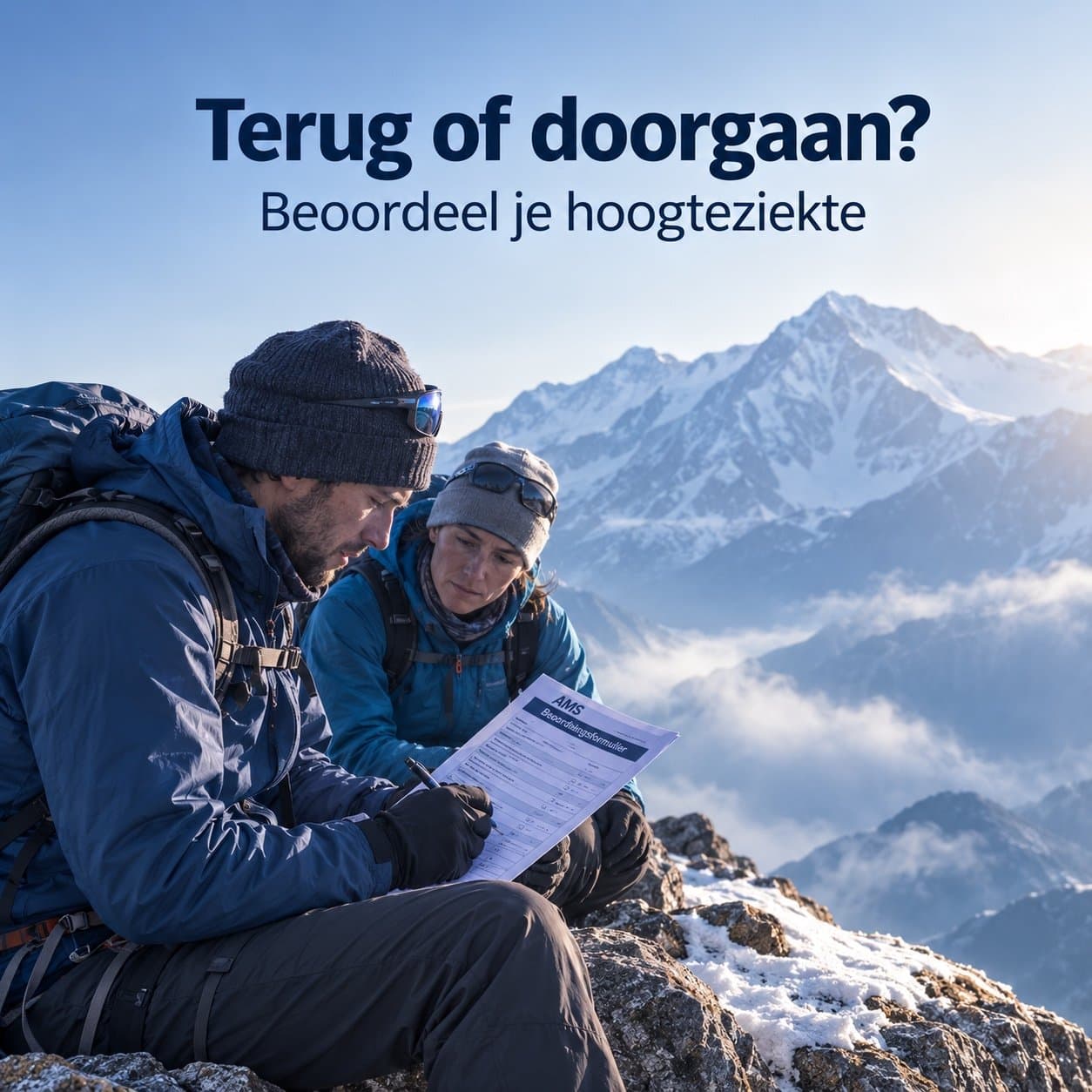
Those climbing to thin air for the first time often don't know how their body will react to the altitude. And those susceptible to altitude sickness will know the uncertainty en route: is this harmless, or the start of something serious? An altitude sickness assessment form helps you answer that question more calmly. You record your symptoms day by day, see the trend, and recognise in time whether acute altitude sickness or cerebral oedema is developing. In this article, you can read what the form tracks, what your AMS score does and doesn't mean, and how to decide whether to continue climbing or descend.
Short answer: An altitude sickness assessment form records your ascent rate, complaints, warning signs, medications, and your breathing and heart rate, allowing you to track the trend over several days. The score provides an indication, never proof. The golden rule remains: when in doubt, always assume altitude sickness and never let a low score override a dangerous symptom.
Conclusion: The form makes a stealthy process visible, but does not replace your judgment.
Nuance: A low score does not rule out a life-threatening condition; the course over the days says more than a snapshot.
Practical hook: Let a travel companion reassess and, if in doubt, descend, even if the figures seem favourable.
What does the altitude sickness assessment form include?
The form follows five points which together give a reliable picture of your condition at altitude. It is best to fill it in together with a travel companion, as you often judge your own symptoms too leniently. If you want to understand what exactly happens as the pressure increases, read first what altitude sickness actually is; the form builds on that.
Why: Show at what altitude and after which day's ascent your complaints began.
Why: The progression over the climbing days shows your condition; a rising score is a serious warning.
Why: signs that can indicate the most serious form: cerebral oedema.
Why: The type and quantity, such as acetazolamide, are important if you need to consult a doctor.
Why: At the beginning and end of each day; partly determining whether you develop pulmonary oedema.
What your breathing and heart rate tell you
Your breathing and heart rate are two of the most useful numbers on the form, precisely because they can indicate early on height lung oedema. In rest and under normal conditions, most people's heart rate is below 80 beats per minute and their breathing rate is below 15 per minute. Therefore, measure your own resting values a few times at home before departing and note an average. Then you will know what your normal levels should be.
In the first few days at altitude, your resting heart rate will naturally increase by 10 to 30 percent as compensation for the lower oxygen levels. During acclimatisation, it will gradually decrease again, but with a stay of no more than ten days, it usually remains somewhat higher than at sea level. Temperature also plays a role: between 20 and 30 degrees, thermoregulation accounts for 10 to 20 percent, although this is unpredictable due to your clothing. Therefore, consider all values as guidelines. However, be alert if your resting heart rate is above 100 in the morning or increases over consecutive days, measured at the same time while at rest.
🧭 In practice
Measure your resting heart rate and breathing at home, a few mornings immediately after waking up, and note the average. Repeat that measurement on the road every morning at the same time. This way you'll be comparing apples with apples and notice an upward trend sooner than if you rely solely on your gut feeling.
What your score on the altitude sickness assessment form means
The form does not distinguish between acute mountain sickness, pulmonary oedema, and cerebral oedema. The number of points indicates severity, but is never proof. A maximum of 24 points can be scored, and it should never come to that. More important than the number is whether there are symptoms that require immediate action, usually descent. Which symptoms at what stage listening helps you make that assessment.
| AMS-score | Interpretation | Action |
|---|---|---|
| Under 5 | Mild complaints | Waiting on site is permitted, possibly with medication, only where rapid descent is possible; do not ascend further until the score has decreased. |
| 5 or higher | Mild to severe altitude sickness | Drastic intervention, usually descending; the higher the score and the faster you climbed, the more urgent. |
| Alarm symptom | Possible brain or lung oedema, even with a low score. | Act directly and descend; never let numbers drown out a dangerous symptom |
Interpretation: minor complaints.
Action: Waiting on-site is permitted, possibly with medication, only where rapid descent is possible; do not ascend further until the score decreases.
Interpretation: mild to severe altitude sickness.
Action: drastic intervention, usually descending; the higher the score and the faster you ascended, the more urgent.
Interpretation: possible brain or lung oedema, even with a low score.
Action: act directly and descend; never let figures drown out a dangerous symptom.
⚠️ Reality check
Theoretically, you can have a low score while something life-threatening is happening. Serious symptoms rarely occur alone, but if they do, they outweigh the total number of points. Therefore, never rely on numbers alone. The form supports your judgment; it does not replace your common sense.
This is how you monitor this lens
Besides the form, a few simple signals will keep your assessment fair. Measure them at the same time each day and focus on the trend, not on a single measurement.
You oxygen saturation dips with altitude; that is normal. A falling trend over several days at the same altitude is a signal. You sleep quality says a lot: restless sleep, waking up breathless or a pounding heart are indicative of a body that has not yet adjusted. You recovery follow your resting heart rate in the morning; if it keeps rising, the strain is increasing. And you symptoms Finally, you fill in the form daily so the trend becomes visible. The decision rule is simple: as long as score, saturation, sleep, and recovery are stable, you can increase; if one of these deteriorates or declines, then you slow down or decrease.
Should I go back or go on?
The core question as you make your way is not a sums problem, but a consideration of trend, severity and the possibility of a quick descent. These rules help you choose.
Rock climbing provided that your score remains low, there are no alarm symptoms, and your breathing, heart rate, and sleep are stable and adjust to the altitude.
To wait and watch Suitable for a score under 5 with mild symptoms, in a location where rapid descent is possible; do not ascend further until symptoms subside.
Descend do you do it with a score of 5 or higher, with a score that builds up over the days, or as soon as you doubt yourself.
Direct action is needed for confusion, loss of coordination, breathlessness at rest, or rattling breathing; this indicates cerebral oedema or pulmonary oedema. Read how to in cases of acute altitude sickness and don't waste time.
Download the assessment form
Would you like to have the questionnaire and the AMS scoring form on hand while on the go? Download the altitude sickness assessment form (pdf) And print it out before you leave.
Prevent altitude sickness before you have to assess
A review form helps along the way, but the strongest protection is built beforehand. Read how to minimise risk with a steady gradient and good preparation.
Frequently asked questions
What is an AMS score?
An AMS score is a rating of your altitude sickness symptoms, which you can use to track the severity and progression over several days. The score goes up to a maximum of 24 points. It provides an indication, not a diagnosis, and should never replace your own assessment.
What score do I need to descend from?
With a score of 5 or higher, descending is usually the wisest course of action. Only below 5 may you wait and see on the spot with mild symptoms, and then exclusively where a rapid descent is possible. If in doubt? Treat it as altitude sickness and descend.
Can I have altitude sickness with a low score?
Yes. A low score does not exclude danger, as serious symptoms such as cerebral or pulmonary oedema can be severe even if the total score remains limited. Therefore, always let an alarming symptom take precedence over the score.
Who is best placed to complete the assessment form?
Ideally, a travel companion, with you. You often judge ailments and behavioural changes in yourself too leniently, especially when confusion is involved. A second pair of eyes notices an escalating trend sooner than you do yourself.
An altitude sickness assessment form is not evidence, but a compass. It makes a creeping process visible, forces you to measure daily, and allows you to intervene in time. Fill it in together with a travel companion, look at the trend rather than a single measurement, and stick to the golden rule: when in doubt, assume altitude sickness. Then the choice between climbing higher and descending remains a conscious one, and not a gamble.