Acclimatising at home for mountain expeditions: preparation time and packages explained
Published 6 February 2026 · 6 min read
Those preparing for a mountain expedition often underestimate how decisive the first days at altitude are. Fatigue, poor sleep or vague headaches are quickly seen as “belonging”, while they are often the result of insufficient acclimatisation. Acclimatising at home for mountain expeditions helps make this risk manageable even before you leave.
The essentials in 30 seconds
Conclusion: Acclimatising at home increases your physiological reserve before heading into the mountains.
Nuance: It does not replace natural acclimatisation, but makes the process more predictable and significantly reduces the risk of altitude sickness.
Practical lead: Start early and build up the hypoxic stimulus step by step using SpO₂.
Why prior acclimatisation is so often underestimated
Many mountain travellers focus on equipment, route and logistics. Acclimatisation gets attention only when complaints arise. That is late. At that point, the body is already reacting under pressure, while the margin to adjust is small. This is precisely why acclimatisation at home is increasingly used in preparation for serious altitude.
The misconception is persistent: “I'll acclimatise on the spot.” In theory, this is true. In practice, time, rest and flexibility are often lacking. A tight travel schedule, group pressure and changing sleeping conditions make natural acclimatisation vulnerable.
Preparing in advance does not mean you rule out symptoms, but it does mean you start with more buffer. You can usually feel that difference in the first few nights.
💡 Did you know?
Many incipient altitude complaints arise not while walking, but at night. Sleep is the time when breathing and oxygen availability are most constant, and therefore the time when hypoxic stress is most clearly felt.
What happens physiologically during acclimatisation
At altitude, available oxygen decreases. The body responds with a series of adaptations. Breathing speeds up, heart rate increases and processes that make oxygen transport more efficient are activated.
A key component is the production of red blood cells. This process takes time. Days to weeks. Those who only start at altitude start this process at a time when performance and recovery are already under pressure.
In addition, sleep architecture changes. Many people experience restless nights, shallow sleep and more frequent waking. This affects recovery, mood and decision-making. Exactly the factors you want to keep sharp during an expedition.
Home acclimatisation responds to this by exposing the body to controlled hypoxia even before departure.
Normobaric hypoxia as a controlled stimulus
Acclimatisation at home involves reducing the oxygen percentage without adjusting the air pressure. This is called normobaric hypoxia. The body experiences less available oxygen, similar to staying at altitude.
The most important stimulus is offered during sleep. This is deliberate. Sleep is prolonged, stable and free from other stressors such as exertion or temperature. This allows the body to make targeted adjustments.
The reaction varies from person to person. This is why measuring is essential. It is not how high your setting is, but how your body reacts that determines the pace.
📊 Research shows
Studies show that structured exposure to hypoxia before staying at altitude can lead to faster ventilatory adaptation and better oxygen saturation in the mountains, provided the stimulus is sufficiently long and individually tailored.
For whom acclimatisation at home makes sense
Not every mountain trip requires the same preparation. Acclimatising at home is especially relevant when:
- you sleep above 3,500 metres
- you have little time to build quietly on site
- you were prone to altitude complaints in the past
- your expedition is physically or mentally demanding
For treks with many rest days, natural acclimatisation may be sufficient. For expeditions with tight schedules, fixed dates or technical objectives, preparation at home offers extra security.
It also helps with mental calm. Knowing that your body is already used to lower oxygen levels changes how you interpret signals.
Preparation time: how long is needed
One of the most frequently asked questions is: how much time do I need to acclimatise at home? The honest answer is: it depends on your goal and your starting point.
In practice, we see roughly three categories:
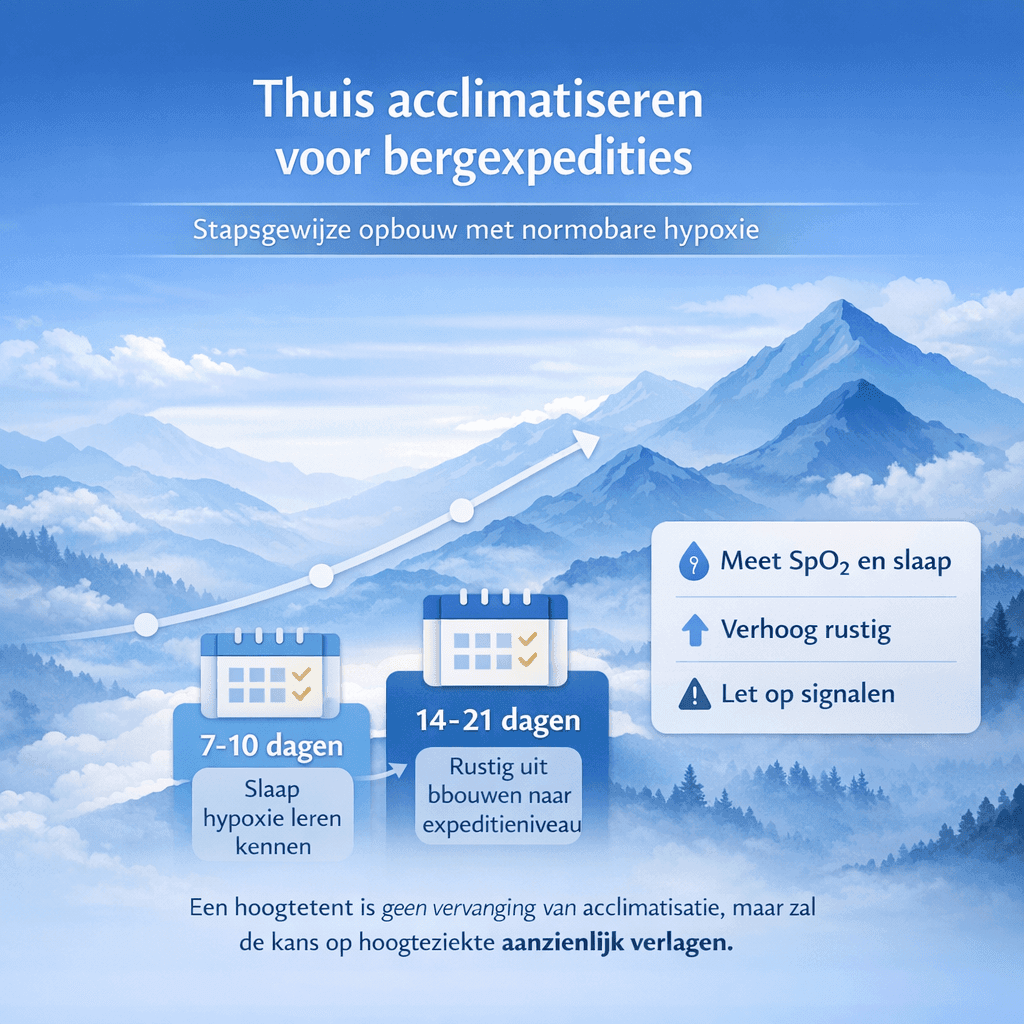
Short 3-week preparation
Suitable for lower targets or as an extra buffer. Your body gets acquainted with hypoxia, but structural adjustments remain limited. This can help make the first nights calmer.
Average preparation of 4 to 5 weeks
This is a realistic and effective period for many mountain travellers. There is noticeable adaptation in breathing and oxygen saturation. Sleep often becomes more stable and recovery improves.
Longer preparation from 6 weeks
For high expeditions or previous problems with acclimatisation. This period provides space to build up slowly and allow the body to really acclimatise.
More important than the duration is the build-up. Increasing too quickly increases the risk of overexertion and poor sleep.
⚠️ Reality check
An altitude tent is no substitute for acclimatisation, but it will significantly reduce the risk of altitude sickness. Don't expect a guarantee, just a better starting position.
Packages and construction in practice
Home acclimatisation is usually offered in altitude tent packages that match the preparation time. The difference is not only in duration, but also in guidance and tutoring.
A good package offers:
- a stepwise increase in the hypoxic stimulus
- monitoring of SpO₂ and sleep
- space to slow down when needed
- advice on rest, training and recovery
The first nights often feel uncomfortable. This is normal. The goal is not as high as possible, but as steady as possible. Consistency outweighs ambition.
Data helps with this. Trends in oxygen saturation say more than single measurements. Are your values falling structurally, or are they stabilising? That determines the next step.
Decision moments and red flags
Preparing also means learning to listen for signals. Not every discomfort is a problem, but some signals require adjustment.
When to continue
- stable or slightly rising SpO₂
- reasonable sleep quality
- recovery feeling improves
When to adapt
- persistent restless sleep
- falling saturation over several days
- increased daytime fatigue
When to slow down or stop
- distinct headache that does not diminish
- nausea or dizziness
- severely deteriorating sleep
Especially at home, you have the luxury of doing this safely. Use that space.
🧭 In practice
Many experienced mountain travellers find that their confidence increases when they learn to steer by data. Not because numbers are leading, but because they juxtapose feeling and reality.
Guidance and customisation
Although acclimatising at home can be done independently, guidance proves valuable. Having someone to watch, add nuance and help interpret prevents hasty conclusions.
It's not about harder or faster, but smarter. Data-driven adjustment helps to stay within safe margins and still prepare effectively.
Anyone in doubt about construction, timing or signals would do well to discuss it with a specialist via our contact page.
Summary reflection
Acclimatising at home changes the start of a mountaineering expedition. Not by removing everything unpredictable, but by better preparing the body for what is to come. This gives calm, overview and often better nights in the crucial first phase.
Those wishing to mirror experiences or seeking guidance on preparation can discuss this at their leisure before the expedition begins.
A well-prepared start makes choices along the way clearer.
❓ Mini-FAQ
Does acclimatising at home also make sense below 3,000 metres?
Usually not necessary, but it can help with short trips or previous sensitivity to altitude.
Should I train in hypoxia or just sleep?
For mountain travel, the primary incentive lies with sleep. That is more stable and easier to dose.