Climbing Kilimanjaro: the ultimate tips & tricks for a safer and more successful summit day
Published 20 April 2026 · 13 min read
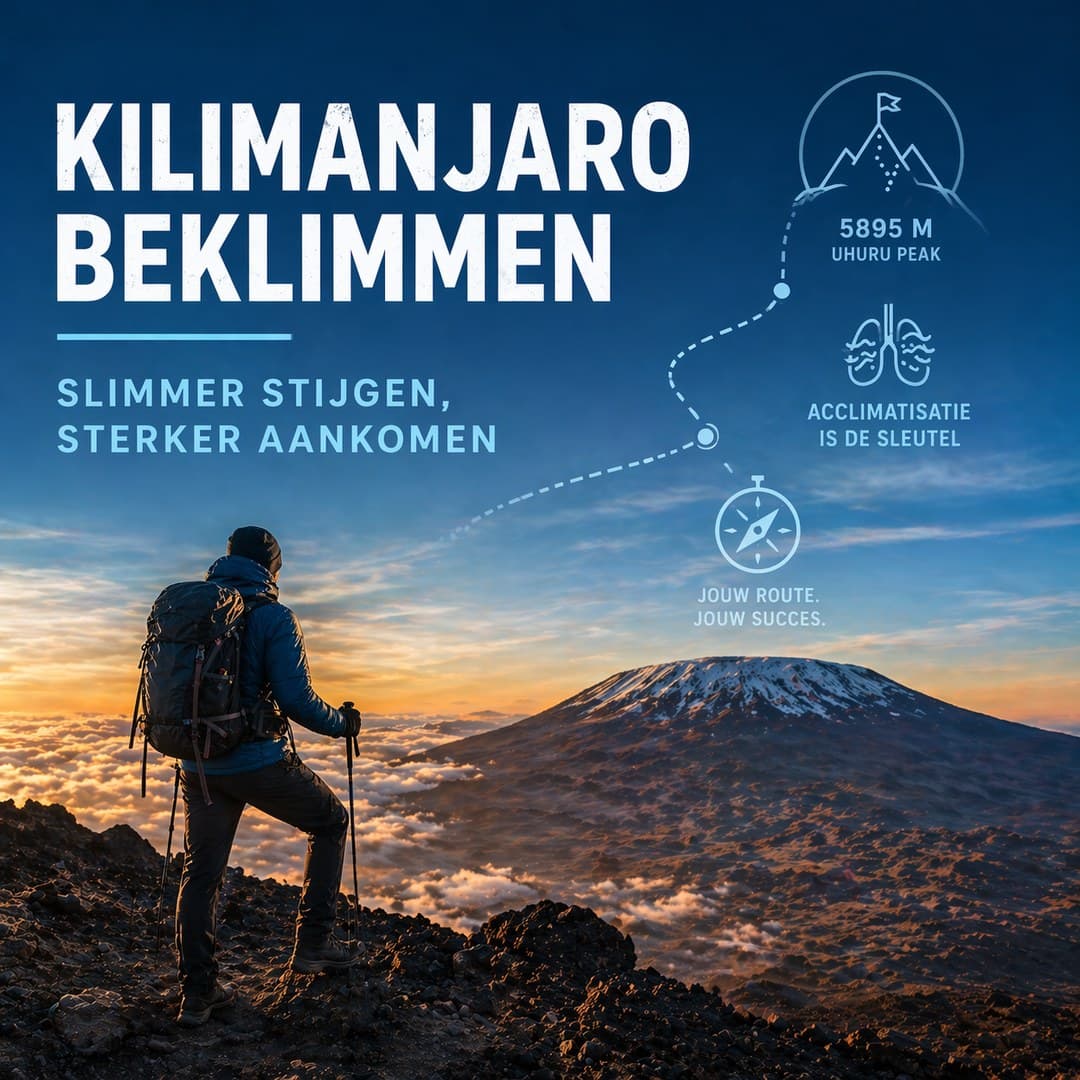
Climb Kilimanjaro sounds to many people like an achievable mountain adventure without technical climbing skills. That is partly true, but that is exactly where it often goes wrong. The challenge is not mainly in rope technique or rock climbing, but in the pace at which your body has to adapt to the altitude. Those who underestimate the mountain usually pay for it not with muscle pain, but with energy loss, nausea, poor sleep or ultimately a failed summit push.
In this article, you won't get a generic travel list, but a decision guide. You will discover which route makes sense for your profile, how to smartly build your preparation at home, which mistakes cost the most chances and when extra pre-acclimatisation really adds value. If you then want to delve further on route choice or daily schedule, also read Best Kilimanjaro route and daily schedule for safe acclimatisation and Best acclimation schedule for Kilimanjaro.
Important: this article will help you make better choices, but does not replace personal medical advice. Especially with previous altitude problems, asthma, sleep apnoea, heart or lung problems, checking with a doctor beforehand is wise.
The essentials in 30 seconds
The most important tip for Kilimanjaro is simple: don't buy speed, buy acclimatisation time. For most people, 7 days is the bare minimum. 8 days is usually the best all-round choice. 9 days gives the most physiological margin.
What makes the difference on the mountain: a leisurely route, polé polé pace, smart food and drink, no ego-decisions when starting symptoms, and preparation that focuses on walking with strain rather than just fitness training.
When extra preparation at home becomes interesting: if you are short on time, have already suffered from altitude, need to run a shorter schedule or simply want to be at the start with more control. An altitude tent does not make the acclimatisation process unnecessary, but it does make it more controlled, measurable and plannable.
Which route suits you best?
The smartest tips & tricks
Preparation from 6 weeks before departure
Recognising height problems early
Packing list and last 48 hours
When an altitude tent makes sense
Frequently asked questions
Instant advice: if you want to maximise your chances of a strong summit day, choose a longer schedule rather than a cheaper or shorter one. Train at home mainly on endurance loads, stair climbing and backpacking. Monitor your pace from day 1. Sleep, hydration and recovery are not side issues on Kilimanjaro, but performance determinants.
Why Kilimanjaro is often underestimated
Kilimanjaro has a treacherous profile. It is one of the most famous high mountains in the world that you can climb without technical alpine skills. This easily creates the idea that it is mainly a matter of fitness. In reality, it is a acclimatisation challenge. Your body has to learn to function with much less available oxygen in a short period of time, while continuing to move, eat, sleep and recover for days at altitude.
This also means that the strongest athlete does not automatically have the best papers. Good basic fitness helps, but it does not protect you from altitude sickness. Instead, many fit people go too fast, eat too little, run too fast on the first days or ignore subtle signals because they feel “good enough”. Those who approach Kilimanjaro smartly will win through dosage rather than bravado.
Uhuru Peak is high enough to punish physiological mistakes mercilessly.
For most tractors, this is the lower limit for a logical schedule.
Not running harder, but rising smarter makes the difference.
Which route suits you best?
The best route is not necessarily the prettiest Instagram route, but the one that suits your goal, your budget, your available holiday days and, above all, your need for acclimatisation margin. In practice, we see the same pattern again and again: the better the altitude profile and the more time your body gets, the better your chances of a fine and stable summit night.
| Route/duration | For whom logical | Plus points | Focal point | Our opinion |
|---|---|---|---|---|
| Marangu 5-6 days | Only for those who choose extremely time-driven and consciously accept more risk | Familiar, huts instead of tents, logistics simple | Not enough acclimatisation time for many people | Not usually our preferred choice |
| Machame 7 days | Trekkers seeking a good balance between time, experience and likelihood of success | Nice profile, strong acclimatisation record, popular choice | Busier on the mountain | Very good minimum |
| Lemosho 8 days | Those for whom quality and acclimatisation margin are more important than the lowest price | Quiet start, strong profile, more margin, often best all-round choice | Slightly more expensive and needing an extra day | Favourite for most people |
| Northern Circuit 9 days | Those who want the biggest margin of safety and most peace on the mountain | Longest profile, best spread, often quietest | More time and budget needed | Best physiological choice |
| Rongai 7 days | Those seeking a quieter side of the mountain and consciously choosing this profile | Less pressure, drier approach | Less forgiving if schedule gets too tight | Can work well, if cleverly constructed |
Marangu 5-6 days
Logical for: only those who choose very time-driven.
Plus: cabins and simple logistics.
Min: too little acclimatisation time for many people.
Verdict: usually not our preferred choice.
Machame 7 days
Logical for: those looking for a good balance.
Plus: nice profile and strong acclimatisation.
Min: popular and therefore busier.
Verdict: very good minimum.
Lemosho 8 days
Logical for: Who puts quality before haste.
Plus: quiet start and plenty of margin.
Min: slightly more expensive and longer.
Verdict: best all-round choice for most tractors.
Northern Circuit 9 days
Logical for: Those who want maximum physiological margin.
Plus: longest and often quietest route.
Min: more holidays and budget needed.
Verdict: best choice if you want to mitigate risk as much as possible.
Rongai 7 days
Logical for: those who consciously choose a quieter profile.
Plus: less crowded.
Min: Shorter variants give less margin.
Verdict: fine route if the schedule is built sensibly.
Practical rule of thumb: when in doubt between “shorter and cheaper” or “longer and quieter”, choose longer and quieter. It feels less spectacular beforehand, but it is usually exactly what makes your summit day better.
The smartest tips & tricks for a stronger Kilimanjaro climb
1. Choose time over bravado
Those who want to finish Kilimanjaro in as few days as possible mainly buy extra insecurity. The mountain rewards patience. Choose a schedule where your body can “recover” rather than one where you hope it will be okay.
2. See polé polé as a strategy, not a tourist cliché
Running slowly helps your breathing, energy consumption and recovery. Those who get impatient on day 1 often lose much more time later on the mountain. Pace is not only a physical choice, but also a decision about how much stress your body has to cope with per day.
3. Train at home on what you will actually do
Running or cycling gives an excellent base, but Kilimanjaro especially requires prolonged walking, stair climbing, maintaining rhythm and recovery with consecutive days of load. So practise also with a daypack, longer walks and climbing at a steady heart rate.
4. Don't start summit day with an empty tank
The final stage is long, cold and mentally demanding. This is precisely why it is crucial that you eat enough in the days before, keep drinking and don't drain your energy unnecessarily. The classic mistake is taking in too little because appetite wanes. Smart trekkers eat more on discipline than on appetite.
5. Monitor your sleep from the first night
Poor sleep at altitude is common. One lesser night is not an immediate problem, but a series of restless nights makes everything harder: recovery, mood, appetite and summit confidence. So treat sleep as a core part of your strategy, not an afterthought.
6. Use your sticks in time, not only when you are tired
Trekking poles help your rhythm, spare your quadriceps during the descent and give extra stability in tired moments. Test them already in your preparation. Summit day is not the time to still figure out how to walk with them.
7. Dress in layers and, above all, think about adjustability
Kilimanjaro is not a mountain for one perfect outfit. You move through multiple climate zones and your body temperature fluctuates. So choose not just warm clothes, but above all a system that allows you to adjust quickly without sweating or chilling.
8. Don't test your shoes on the mountain
New shoes, ill-fitting socks or a backpack that chafes seem like small details. On day 1, they are not too bad. On day 5, they are serious energy and motivation leaks. Everything you wear on the mountain should already feel “dull familiar” before departure.
9. Don't automatically confuse a headache with dehydration
Many trekkers immediately look for water or a snack and hope that will be the end of it. Sometimes this is justified. Sometimes a headache is the first signal that your body is struggling with the altitude. So follow the overall picture: headache plus nausea, worse walking, worse sleep or increasing malaise always deserves extra attention. For more in-depth information, you can also read our article on altitude sickness read.
10. Keep your ego out of medical decisions
On Kilimanjaro, stubbornness is not a virtue. An extra rest, a slower pace or not climbing any further in case of worsening symptoms is not weakness, but good mountain behaviour. Many problems escalate precisely because someone “still wants to see how things go”.
11. Get your expectations right
A successful climb does not automatically mean that every day feels great. Altitude sometimes makes things syrupy. Those who understand this in advance are less likely to be mentally upset by a down day. The best mindset is not “I need to feel strong every day”, but “I need to react smartly to what my body shows every day”.
12. Also think ahead to the descent
Many people focus entirely on Uhuru Peak, when in fact the descent is often surprisingly tough on knees, feet, concentration and energy. So make sure you don't drain everything at the top. A strong summit day is only really strong if you come down controlled afterwards too.
The best Kilimanjaro trick is not actually a trick: Build in as much predictability as possible. Choose a good profile, test equipment beforehand, plan recovery, and make decisions small and rational. That usually delivers more than “toughness” or extra motivation on the day.
Preparation from 6 weeks before departure
The best preparation for Kilimanjaro is specific, achievable and consistent. You don't need to become an elite athlete in six weeks. You mainly want to build up three things: hiking duration, muscle endurance and recovery between consecutive load days.
| Period | Focus | What you do concretely | Target |
|---|---|---|---|
| Week 6-5 | Laying the foundation | 2 longer walks per week, 1 strength workout, 1 gentle endurance workout | Building load capacity without spikes |
| Week 4-3 | Training more specifically | Stair climbing or hill training, hiking with daypack, longer time on legs | Climbing muscles and rhythm training |
| Week 2 | Combination incentive | 1 weekend with two consecutive days of hiking, equipment testing, nutrition testing | Simulate recovery between mountain days |
| Week 1 | Reduce and sharpen | Training volume down, prioritise sleep, no heroic final sessions | Leaving fit and refreshed |
Laying the foundation
Focus: build load capacity.
Specifically: 2 longer walks, 1 power walk, 1 gentle endurance workout.
Training more specifically
Focus: climbing muscles and rhythm.
Specifically: stair climbing, hill training, hiking with backpack.
Combination incentive
Focus: recovery between consecutive days.
Specifically: 2 consecutive days of hiking, equipment and nutrition testing.
Reduce and sharpen
Focus: fresh at the start.
Specifically: volume down, sleep high, no final stunt workouts.
What is smart though
- Regular walking at pace at which you can talk
- Climbing stairs or elevation with gentle backpack loading
- Practising with shoes, sticks and backpack
- A few sessions with extended time on legs
What is often overrated
- Only fast cardio as preparation
- Extra heavy training last week
- Relying on willpower without a rhythm plan
- Thinking that top condition automatically compensates for altitude
Recognising height problems early: this model helps
The biggest mistake with altitude complaints is usually not that someone does not feel the signals, but that they try to reason them away for too long. Therefore, use a simple traffic light model. Once you agree this in advance with yourself or your travel partner, you will make better decisions on the mountain.
| Zone | What you notice | What you do | Interpretation |
|---|---|---|---|
| Green | Slight headache, mild restless sleep, otherwise stable | Quieter pace, drink and eat well, no extra rush | Often still matching height adjustment |
| Orange | Headache plus nausea, dizziness, markedly worse functioning | No further rise, additional recovery, reassessment | Serious signal that your body is lagging behind |
| Red | Symptoms increase at rest, shortness of breath at rest, confusion, walking unsteadily | Descend immediately and arrange medical assistance | No argument, safety first |
Mild complaints, stable picture
Quieter pace, drink and eat well, don't rush.
Complaints increase
No further rise. Stabilise first and reassess.
Alert
Immediately descend and arrange medical attention. There is no toughness involved here.
Important nuance: drugs can sometimes be part of a doctor's plan, but should never become an excuse to ignore clear alarm signals. Downhill remains the core intervention for worsening severe symptoms.
Smart packing list and the last 48 hours before departure
A good packing list is not just about “bring everything”, but about removing friction. Anything that causes friction, cold, wet feet, bad sleep or search stress costs energy that you miss later on the mountain.
What you want to check last 48 hours
- Shoes are broken in and remain comfortable even with thicker socks
- Trekking poles are well adjusted and tested
- Gloves, hat, baselayers and jacket are logically layered
- Daily snacks are practical and easy to eat at height
- Water bottles or drinking system are easily accessible
- Headlamp works and spare batteries are in a fixed place
- You know which items you want to be able to grab quickly during summit night
- You will not leave the expedition tired, dehydrated or half sick
The last few days before departure are not the time to want to get “extra fit”. They are meant to pile on rest, sleep, equipment confidence and mental clarity. A fresh start almost always delivers more on Kilimanjaro than a rushed final training push.
When a high altitude tent really adds value to Kilimanjaro
For some trekkers, a good route plan is enough. For others, extra pre-acclimatisation at home is a smart lever. It can be particularly interesting in these situations:
- you have limited time on the mountain and want to start with more margin
- You chose a more compact scheme anyway and want to dampen risk better
- you were previously suffering from altitude or don't want to be completely dependent on “how things turn out”
- you want controlled, measurable and plannable acclimatisation at your own pace
What is important, though, is the right expectation. A high altitude tent is no substitute for acclimatisation on the mountain. It does make the process more controlled, measurable and plannable and can significantly reduce the risk of altitude problems, but it never gives a 100 per cent guarantee. This is precisely why it works especially well in combination with a smart route plan, leisurely pace and good mountain behaviour.
Those wishing to delve deeper into this can then read further on the rental service page. Or here read altitude tent experiences from other Kilimanjaro climbers.
Frequently asked questions about climbing Kilimanjaro
Can a beginner climb Kilimanjaro?
Yes, provided you don't confuse “beginner” with unprepared. You don't need technical climbing experience, but you do need realistic route choice, sufficient time, discipline in pace and solid preparation at home.
What is the best route for most people?
For most trekkers, Lemosho in 8 days is the strongest all-round choice. Northern Circuit is even more favourable physiologically, but requires more time and budget. Machame in 7 days is often a good minimum if you have fewer days.
Is fitness or acclimatisation more important?
You need both, but acclimatisation remarkably often determines the outcome. A strong bike helps, but a smart altitude profile and good pace are usually more decisive than extra fitness alone.
Do you necessarily need to take medication?
No. That is not a standard condition for a successful ascent. Medication may be appropriate for some people, but that belongs in a personal medical plan and not a general “shortcut” mentality.
How do you know if your preparation is good enough?
Good preparation rarely feels spectacular. It feels stable. You can walk for several hours without drama, your equipment is tested, your recovery is in order, and you have your expectations sharp. That's more important than one heroic day of training.
Want to start Kilimanjaro smarter prepared?
Those who start their preparation early buy, above all, rest. Not only physically, but also mentally. A good plan at home makes better decisions on the mountain easier.
Want to see if a high altitude tent makes sense for your Kilimanjaro planning, or first see how other mountain athletes experienced their preparation? Then use the links below.