Preventing altitude sickness: complete guide to symptoms, prevention and emergency plan
Published 17 January 2026 · 4 min read
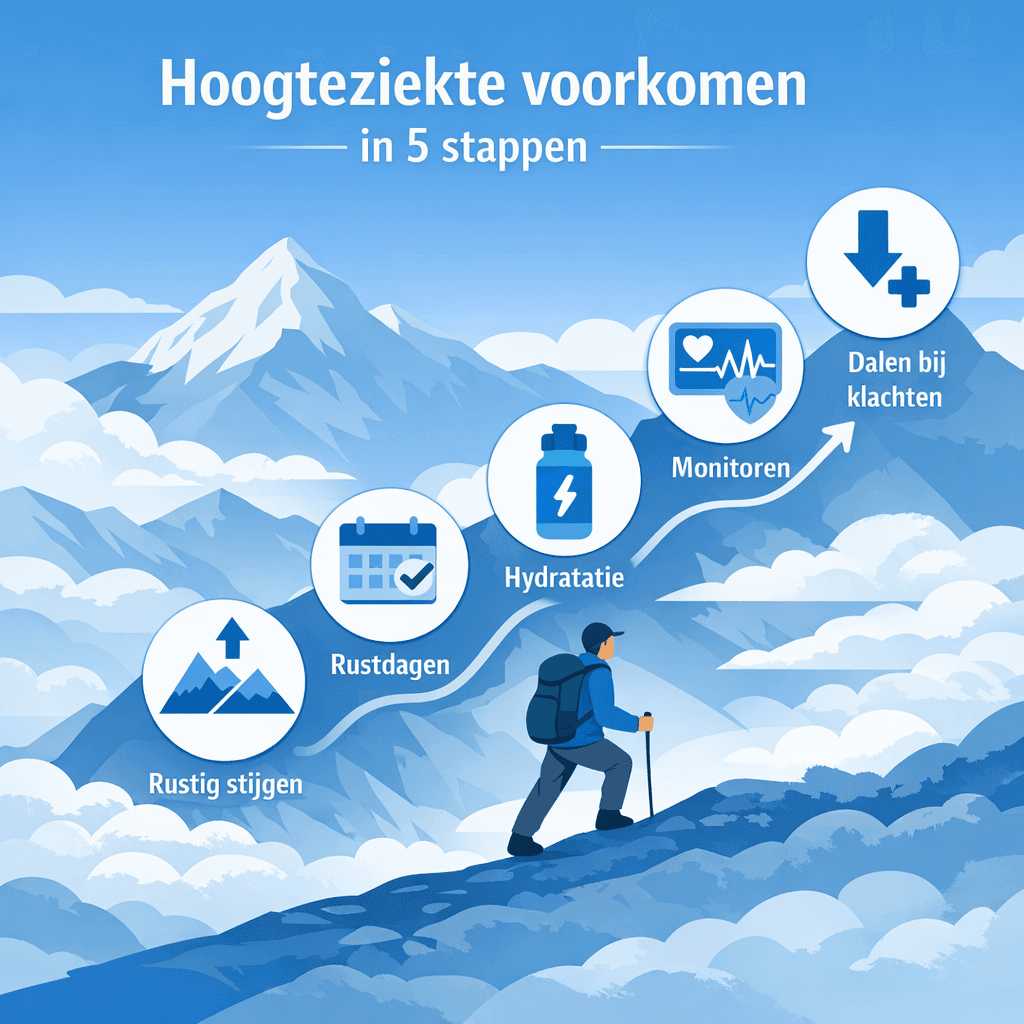
Prevent altitude sickness does not start on the mountain, but in your preparation. Yet many athletes and mountain travellers underestimate how quickly oxygen deprivation affects their bodies. In this guide, you will learn exactly what altitude sickness is, how to recognise it, how to lower your risk and what to do if symptoms do arise. No simplifications, no scare stories. But gripes, nuance and practical decisions.
When you get above 2,500 metres, your physiology changes. Not everyone feels this immediately, but no one is immune. Preventing altitude sickness is therefore not a matter of luck, but of insight, pace and planning.
What exactly is altitude sickness?
Altitude sickness, also known as Acute Mountain Sickness (AMS), occurs when your body is given insufficient time to adapt to lower oxygen pressure. Your blood then contains less available oxygen, putting pressure on organs and brain.
Most common complaints:
- Headache
- Nausea or loss of appetite
- Dizziness
- Fatigue
- Sleep problems
In more severe cases, this may progress to HACE (brain oedema) or HAPE (pulmonary oedema). These are medical emergencies.
What does this mean concretely?
For planning: above 2,500 metres, you should actively take acclimatisation.
For strain: your body recovers more slowly.
For risk: symptoms are signals, not obstacles to ignore.
Why altitude sickness is so often misunderstood
Altitude sickness is often seen as something that only happens to untrained people. This is wrong. Fit athletes in particular are sometimes at extra risk because they want to ascend too fast.
Common misconceptions
- “I'm fit, so I don't get altitude sickness,” he says.”
Fitness does not protect against oxygen deprivation. Adaptation is a different process from fitness. - “If I don't have a headache, everything is fine.”
Headache is just one of the possible signs. Sleep, appetite and cognitive clarity are at least as important. - “You get used to it, so walking through helps.”
Rising too quickly actually increases the risk of exacerbation.
These assumptions are not only incomplete, but sometimes downright dangerous.
The physiology behind altitude sickness
At altitude, oxygen pressure drops. Your body reacts with:
- Accelerated breathing
- Increase in heart rate
- Increased red blood cell production
But these adjustments take time. Especially in the first few days, your oxygen saturation is lower than you are used to.
What does this mean concretely?
For planning: first days are fragile.
For load: workouts and stages should be lighter.
For recovery: sleep and nutrition become more critical.
Scenario 1: The avid trail runner
An experienced trail runner arrives at 3200 metres and feels fit. He immediately decides to run his normal pace. After two days, headaches and nausea develop. Not due to poor fitness, but due to too fast a load without acclimatisation.
Insight: speed and oxygen adaptation do not coincide.
Scenario 2: The tractor at 4500 metres
A trigger sleeps poorly, eats little and feels emotionally flat. No headache, but clear signs of stress on the system. He ignores this, until suddenly severe nausea follows.
Insight: altitude sickness often starts subtly.
How can you prevent altitude sickness?
1. Build height gradually
Ascend above 3,000 metres no more than 300 to 500 altimeters per night of sleep.
2. Plan rest days
One acclimatisation day every 3-4 days with no ascent.
3. Monitor your body
Note sleep quality, resting heart rate, SpO2 trends and appetite.
4. Hydration and carbohydrates
Sufficient drinking and energy intake support adaptation.
5. Listen earlier than you think is necessary
Not at failure, but at first signs.
What does this mean concretely?
For planning: book extra days.
For load: accept slower progress.
For risk: early intervention prevents escalation.
High altitude tent and pre-acclimatisation
Pre-acclimatisation with an altitude tent can reduce the risk of altitude sickness when carefully built up. Altitude is adjusted individually and incrementally based on measured SpO2 values.
Guidelines:
- At least 4 weeks
- Optimal 5 weeks
- Maximum 6 weeks
This does not replace acclimatisation on site, but increases your starting position.
When should you adjust or stop?
- Persistent headache despite rest
- Decline in SpO2 over several days
- Poor sleep and reduced clarity
- Persistent nausea
Then dropping is not weakness, but sanity.
Decision moments and signals
Continuing: mild symptoms, stable SpO2, good recovery feeling.
Adjust: worse sleep, mild nausea, falling trends.
Stop or drop: neurological symptoms, severe shortness of breath, exacerbation.
Internal floor
Read more about acclimatisation in Preventing altitude sickness (pillar), check out the Height-to-oxygen table and deepen your basic knowledge via Acclimatisation basics.
Logical next step
Would you like personal advice on pre-acclimatisation or guidance on altitude preparation? Then Altitude Dream can work with you to find a suitable schedule based on your target altitude, schedule and experience.
Resume
Preventing altitude sickness does not require a perfect strategy, but conscious choices. Understanding your body, respecting adaptation and being willing to slow down make all the difference.
Taking height seriously not only increases safety, but also perception.